

Arizona Pest Library
Identify the pests invading your home and learn what attracts them, the risks they pose, and how Pest Control Bros eliminates them for good.
🦂Scorpions
 High risk
Arizona Bark Scorpion
Centruroides sculpturatus
The most venomous scorpion in North America and the most common scorpion pest in Arizona homes.
 Low risk
Striped Tail Scorpion
Vaejovis spinigerus
One of the most common scorpions in Arizona. Its sting is painful but not medically significant for healthy adults.
 Low risk
Desert Hairy Scorpion
Hadrurus arizonensis
The largest scorpion in North America. Intimidating in size but its venom is relatively mild — similar to a bee sting.
 Low risk
Yellow Ground Scorpion
Paravaejovis confusus
A small, uniformly yellow scorpion common in Arizona's lower desert elevations. Sting is mild and not medically significant.
 Low risk
Giant Desert Hairy Scorpion
Hadrurus spadix
A close relative of the desert hairy scorpion and equally large. Found in the hottest, driest desert regions of western Arizona.
 Low risk
Arizona Grass Scorpion
Chihuahuanus coahuilae
A slender, pale scorpion found in grassy and vegetated areas of southern Arizona. Rarely enters homes.
 Low risk
Dune Scorpion
Smeringurus mesaensis
A pale, sand-colored scorpion adapted to sandy desert dunes. Found in western Arizona's sandy desert regions.
 Low risk
Lesser Striped Scorpion
Vaejovis lapidicola
A small rock-dwelling scorpion found under stones and in rocky terrain throughout central and southern Arizona.
 Low risk
Cave Scorpion
Pseudouroctonus apacheanus
A dark, slender scorpion found in caves, mines, and deep rock crevices in Arizona's mountain ranges.
 None risk
Pseudoscorpion
Order Pseudoscorpiones
A tiny, harmless arachnid that resembles a scorpion without a tail — a beneficial predator of mites, booklice, and small insects found throughout Arizona homes.
🪲Termites
 High risk
Termites
Reticulitermes / Incisitermes spp.
Silent destroyers that cause billions in structural damage annually. Arizona has two primary species: subterranean and drywood termites.
High riskSubterranean Termites
Reticulitermes spp.
The most destructive termite species in Arizona. Subterranean termites live underground and travel through mud tubes to silently devour the structural wood of your home.

🐀Rodents
 High risk
Roof Rats
Rattus rattus
Agile climbers that invade attics and upper structures. A major problem in Phoenix metro neighborhoods with citrus trees.
 Medium risk
Pack Rats (Woodrats)
Neotoma albigula
Native Arizona rodents notorious for building large stick nests and chewing through vehicle wiring and HVAC systems.
🪳Cockroaches
 High risk
Cockroaches
Periplaneta americana / Blattella germanica
Arizona is home to both American and German cockroaches. Both species spread bacteria and trigger asthma and allergy symptoms.
 High risk
German Cockroach
Blattella germanica
The most problematic indoor cockroach in the world. German cockroaches reproduce explosively — a single female can produce thousands of offspring in a year.
 High risk
American Cockroach
Periplaneta americana
The largest common cockroach in Arizona — up to 2 inches long. Also called 'waterbugs,' they enter homes from sewers and outdoor areas.
 High risk
Oriental Cockroach
Blatta orientalis
Dark, shiny cockroaches that prefer cool, damp areas. Often called 'waterbugs' or 'black beetles,' they are common in basements and drains.
 Medium risk
Brown-Banded Cockroach
Supella longipalpa
A small cockroach that prefers warm, dry areas — unlike most species. Found throughout the home, not just in kitchens and bathrooms.
 Medium risk
Turkestan Cockroach
Blatta lateralis
An invasive species rapidly replacing the oriental cockroach in the Southwest. Thrives in Arizona's outdoor environments and utility areas.
 Medium risk
Smokybrown Cockroach
Periplaneta fuliginosa
A large, uniformly dark brown cockroach that is an excellent flier. Common in tree canopies and around outdoor lighting in Arizona.
 Medium risk
Australian Cockroach
Periplaneta australasiae
Similar to the American cockroach but with distinctive yellow markings. Found in warm, humid outdoor areas and greenhouses throughout Arizona.
 Low risk
Surinam Cockroach
Pycnoscelus surinamensis
A burrowing cockroach that damages plant roots in gardens and greenhouses. Rarely found indoors but a significant plant pest.
 Low risk
Field Cockroach
Blattella vaga
A small outdoor cockroach common in Arizona's desert landscaping. Often mistaken for the German cockroach but prefers to live outdoors.
 Low risk
Three-Lined Cockroach
Luridiblatta trivittata
A small, distinctively striped outdoor cockroach found in Arizona's desert scrub and rocky terrain. Rarely a household pest.
🕷Spiders
 High risk
Black Widow Spider
Latrodectus hesperus
The western black widow is common throughout Arizona and produces venom 15 times more potent than a rattlesnake's.
 High risk
Arizona Brown Spider
Loxosceles arizonica
Arizona's native recluse spider. Its venom can cause necrotic skin lesions and requires medical attention. Found in dry, undisturbed areas throughout the state.
 High risk
Desert Recluse
Loxosceles deserta
A recluse spider adapted to Arizona's driest desert regions. Medically significant with necrotic venom, found primarily in low desert and sandy terrain.
 High risk
Western Black Widow
Latrodectus hesperus
The most venomous spider in Arizona. The female's neurotoxic venom can cause severe systemic symptoms. Identified by the red hourglass on the abdomen.
 Medium risk
Brown Widow
Latrodectus geometricus
A tan-to-brown widow spider with an orange hourglass. Less venomous than the black widow but increasingly common in Arizona urban areas.
 Medium risk
Red Widow
Latrodectus bishopi
Native to Florida scrub habitat, the red widow is not established in Arizona but is occasionally discussed due to its striking appearance and widow relationship.
 Low risk
Wolf Spider
Hogna / Rabidosa spp.
Large, fast-moving ground hunters that chase down prey instead of spinning webs. Common in Arizona yards and occasionally found indoors.
 Low risk
Giant Crab Spider
Olios giganteus
One of Arizona's largest spiders, with a leg span up to 3 inches. A fast-moving hunter that enters homes to chase prey. Alarming but harmless.
 Low risk
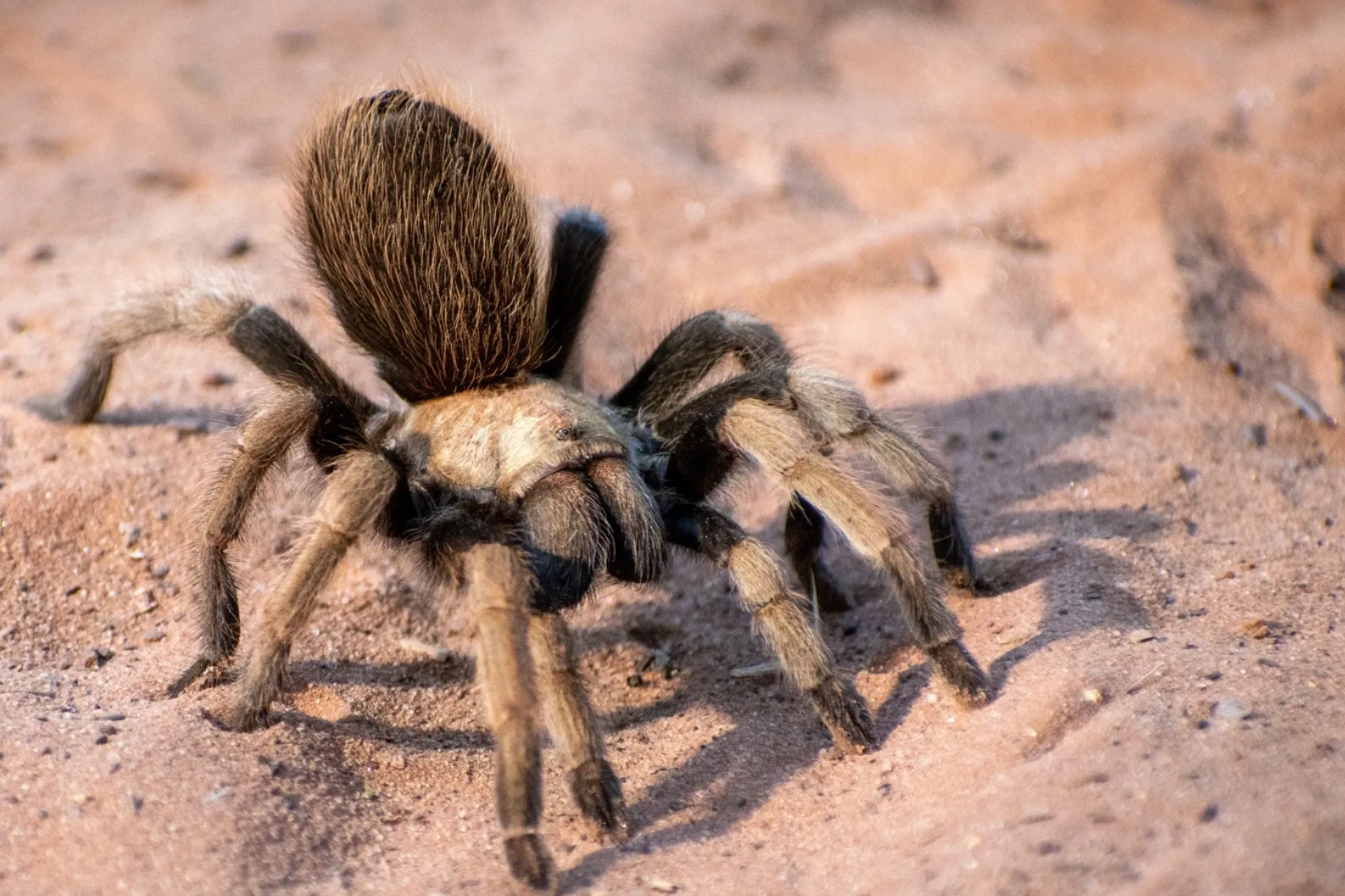
Desert Tarantula
Aphonopelma chalcodes
Arizona's iconic large, hairy spider. Despite their intimidating size, desert tarantulas are docile and their venom is mild — less potent than a bee sting.
 Low risk
Jumping Spider
Phidippus / Habronattus spp.
Small, curious, and colorful spiders with exceptional eyesight. Jumping spiders are active daytime hunters and are completely harmless to humans.
 Low risk
Cellar Spider
Pholcus phalangioides
The long-legged 'daddy long-legs' spider of indoor spaces. Completely harmless and actually beneficial — they prey on other spiders including black widows.
 Low risk
Southern House Spider
Kukulcania hibernalis
A large, dark spider commonly found in and around Arizona homes. Males are often mistaken for brown recluses but are harmless.
 Low risk
Orb-Weaver Spider
Araneidae (family)
The classic circular web-spinning spiders of Arizona gardens and yards. Large, colorful, and completely harmless — beneficial predators of flying insects.
 Low risk
Spotted Orb-Weaver
Neoscona oaxacensis
One of Arizona's most common large orb-weavers. Builds webs near lights at night and is highly variable in color — from pale yellow to deep reddish-brown.
 Low risk
Western Spotted Orb-Weaver
Neoscona arabesca
A close relative of the spotted orb-weaver, common in Arizona's grasslands and desert scrub. Builds webs in low vegetation and grasses.
 Low risk
Garden Spider
Argiope aurantia
Arizona's most striking orb-weaver — bold yellow and black with a distinctive zigzag stabilimentum in the web. Large, beautiful, and completely harmless.
 Low risk
Banded Garden Spider
Argiope trifasciata
A close relative of the garden spider with silver and yellow banding. Common in Arizona grasslands and gardens in late summer.
 Low risk
Green Lynx Spider
Peucetia viridans
A bright green ambush predator found on flowering plants and shrubs. One of Arizona's most colorful spiders and a valuable agricultural beneficial.
 Low risk
Lynx Spider
Oxyopes spp.
Agile, long-legged hunting spiders found on vegetation throughout Arizona. Fast and alert, they chase down prey without using a web.
 Low risk
Long-Jawed Orb-Weaver
Tetragnatha spp.
Slender, elongated spiders found near water in Arizona. They build horizontal orb webs over streams and ponds and have distinctive large chelicerae.
 Low risk
Funnel Weaver
Agelenopsis spp.
Builds flat sheet webs with a funnel retreat in grass and low vegetation. Common in Arizona yards, especially after monsoon rains.
 Low risk
Grass Spider
Agelenopsis aperta
Arizona's most common funnel weaver, found in lawns and grasses statewide. Builds flat sheet webs that sparkle with dew in the morning.
 Low risk
Hacklemesh Weaver
Callobius spp.
Builds irregular, tangled mesh webs in rock crevices and under bark. Found in Arizona's mountain ranges and cooler, higher elevation areas.
 Low risk
Ground Spider
Gnaphosidae (family)
Fast-moving nocturnal hunters found under rocks and debris throughout Arizona. They do not spin webs and are completely harmless.
 Low risk
Running Crab Spider
Philodromus spp.
Flat, fast-moving spiders found on bark and vegetation throughout Arizona. They move sideways like crabs and are excellent camouflage artists.
 Low risk
Crab Spider
Misumena / Misumenops spp.
Ambush predators that wait motionless on flowers for visiting insects. Some species can change color to match their flower. Harmless and highly beneficial.
 Medium risk
Sac Spider
Cheiracanthium / Clubiona spp.
Small, pale spiders that build silken sacs in corners and on vegetation. Responsible for many indoor spider bites in Arizona — bites cause localized pain and slow-healing wounds.
 Low risk
False Widow
Steatoda spp.
Dark, round-bodied spiders often mistaken for black widows. False widows are common in Arizona homes and are harmless — their bite causes only minor irritation.
 Low risk
Cobweb Spider
Theridiidae (family)
The family that includes black widows and false widows. Most cobweb spiders are small, harmless, and responsible for the tangled webs in corners of rooms.
 Low risk
Ant-Mimic Spider
Castianeira / Myrmarachne spp.
Spiders that have evolved to look and move like ants. Found throughout Arizona, they mimic ants to deter predators and approach prey.
 Low risk
Spitting Spider
Scytodes thoracica
A unique spider that captures prey by spitting venomous silk at high speed. Slow-moving and completely harmless to humans, found in Arizona homes.
 Low risk
Trapdoor Spider
Aptostichus / Bothriocyrtum spp.
Builds a hinged silk-and-soil door over its burrow and ambushes passing prey. A fascinating desert spider that is rarely encountered and completely harmless.
 Low risk
Camel Spider
Solifugae (order)
Not a true spider — camel spiders are arachnids in their own order. Fast, aggressive-looking, and the subject of many myths. Their bite is painful but not venomous.
🐜Ants
 Medium risk
Fire Ants
Solenopsis invicta
Aggressive stinging ants that build large mounds in yards and can deliver hundreds of stings in seconds when disturbed.
 Medium risk
Harvester Ant
Pogonomyrmex spp.
Large seed-collecting ants that create bare, gravelly mounds in Arizona yards and deliver one of the most painful stings of any insect.
 Medium risk
Red Harvester Ant
Pogonomyrmex barbatus
One of the most common and aggressive harvester ants in Arizona, known for its fiery red color, painful sting, and large bare mounds.
 Medium risk
Western Harvester Ant
Pogonomyrmex occidentalis
A widespread harvester ant of the western US that builds prominent gravel mounds and delivers a painful sting when disturbed.
 Low risk
Black Harvester Ant
Messor pergandei
A large, all-black seed-harvesting ant common in Arizona deserts that builds deep underground colonies and forages in long trails.
 High risk
Fire Ant
Solenopsis spp.
Aggressive stinging ants that build soft, irregular mounds and swarm instantly when disturbed — a serious threat to people, pets, and livestock.
 High risk
Southern Fire Ant
Solenopsis xyloni
Arizona's native fire ant species — aggressive, polymorphic, and capable of delivering painful multiple stings when their mound is disturbed.
 High risk
Imported Red Fire Ant
Solenopsis invicta
One of the most destructive invasive insects in the US — forms massive colonies, stings aggressively, and is spreading into Arizona.
 Low risk
Argentine Ant
Linepithema humile
A highly invasive tramp ant that forms massive supercolonies, invades homes in huge numbers, and is extremely difficult to eliminate.
 Low risk
Odorous House Ant
Tapinoma sessile
Small dark ants that emit a distinctive rotten-coconut odor when crushed — a common kitchen and bathroom invader across Arizona.
 Medium risk
Carpenter Ant
Camponotus spp.
Large ants that excavate wood to build galleries — a structural pest that can cause significant damage to Arizona homes over time.
 Medium risk
Black Carpenter Ant
Camponotus pennsylvanicus
The largest and most recognizable carpenter ant in North America — an all-black wood-nesting species that can damage Arizona home structures.
 Medium risk
Desert Carpenter Ant
Camponotus vicinus
A large, colorful carpenter ant native to the Sonoran Desert that nests in dead wood and is a common structural pest in Arizona homes.
 Low risk
Crazy Ant
Nylanderia fulva / Paratrechina longicornis
Fast-moving, erratic ants named for their unpredictable zigzag movement — a growing nuisance pest in Arizona homes and electronics.
 Low risk
Rover Ant
Brachymyrmex patagonicus
Tiny dark ants that invade Arizona homes in large numbers — often mistaken for odorous house ants but without the telltale smell.
 Low risk
Little Black Ant
Monomorium minimum
One of the smallest ants in Arizona — jet black, fast-moving, and a persistent kitchen invader that nests in soil and wall voids.
 Low risk
Pavement Ant
Tetramorium immigrans
Small brown ants that nest under sidewalks, driveways, and slabs — pushing up telltale piles of fine soil through cracks in pavement.
 Medium risk
Pharaoh Ant
Monomorium pharaonis
A tiny, pale ant that is one of the most difficult household pests to eliminate — notorious for spreading through hospitals and multi-unit buildings.
 Low risk
Thief Ant
Solenopsis molesta
Tiny yellowish ants that steal food and larvae from neighboring ant colonies — and are one of the hardest household ants to spot and treat.
 Low risk
Velvety Tree Ant
Liometopum occidentale
A fast-moving, velvety-black ant that nests in trees and dead wood — and releases a distinctive foul odor when crushed.
 Low risk
Acrobat Ant
Crematogaster spp.
Named for their habit of raising their heart-shaped abdomen over their head when alarmed — a common wood-nesting ant in Arizona.
 Low risk
Pyramid Ant
Dorymyrmex insanus
A small, fast-moving desert ant named for the distinctive pyramid-shaped mound it builds — common in Arizona lawns and sidewalk cracks.
 Low risk
Forelius Ant
Forelius pruinosus
Tiny, fast-moving desert ants that form dense foraging trails and are among the most heat-tolerant ants in the Sonoran Desert.
 Medium risk
Leafcutter Ant
Acromyrmex versicolor
Arizona's remarkable fungus-farming ant — cuts and carries leaf fragments to underground gardens, and can strip a plant overnight.


🐛Centipedes
 High risk
Giant Desert Centipede
Scolopendra heros
The largest centipede in North America — up to 8 inches long with a painful, medically significant bite. Common across Arizona's desert terrain and occasionally found indoors.
 Medium risk
Tiger Centipede
Scolopendra polymorpha
Arizona's most commonly encountered large centipede — variable in color with banded legs, a painful bite, and a preference for rocky desert habitat near homes.
 Medium risk
Common Desert Centipede
Scolopendra subspinipes
A widespread, medium-large centipede found across Arizona's desert lowlands — a capable predator with a painful bite that occasionally invades homes and garages.
 Low risk
Green Desert Centipede
Scolopendra viridis
A small, slender centipede with a distinctive greenish tint found in Arizona's desert grasslands and rocky terrain — less dangerous than larger Scolopendra species but still capable of a painful bite.
 Low risk
Stone Centipede
Lithobius forficatus
A flat, fast-moving centipede with 15 pairs of legs found under rocks, bark, and garden debris — a common garden and occasional indoor pest across Arizona.
 None risk
Soil Centipede
Geophilus flavus
A long, slender, worm-like centipede that lives entirely underground — harmless to humans and rarely seen above the soil surface except after heavy rain.
 Low risk
House Centipede
Scutigera coleoptrata
The most commonly seen centipede indoors — fast, long-legged, and alarming in appearance but actually a beneficial predator of cockroaches, spiders, and silverfish.
 Low risk
Desert Soil Centipede
Himantarium gabrielis
A slender, multi-legged centipede adapted to Arizona's arid soils — rarely seen above ground but occasionally encountered in irrigated yards and garden beds.
 Low risk
Cryptops Centipede
Cryptops hortensis
A pale, eyeless centipede with 21 leg pairs that lives in soil and leaf litter — rarely seen but occasionally found in Arizona gardens, basements, and crawl spaces.
 Low risk
Brown Stone Centipede
Lithobius melanops
A small, dark brown centipede with 15 leg pairs found under rocks and bark across Arizona — a common garden species that occasionally enters homes in search of moisture.

🐛Crickets
 Low risk
House Cricket
Acheta domesticus
The classic chirping cricket that invades Arizona homes in summer — harmless to people but maddening at 2 a.m.
 Low risk
Field Cricket
Gryllus spp.
Large, robust black crickets that invade Arizona properties in massive numbers during monsoon season.
 Low risk
Tropical House Cricket
Gryllodes sigillatus
A heat-loving cricket that thrives in Arizona's desert climate year-round — and chirps relentlessly inside walls.
 Low risk
Camel Cricket
Ceuthophilus spp.
Humpbacked, spider-like crickets that lurk in dark, damp spaces — startling but harmless.
 Low risk
Cave Cricket
Ceuthophilus spp. / Diestrammena spp.
Silent, humpbacked crickets adapted to dark underground environments — found in Arizona caves, mines, and basements.
 Low risk
Jerusalem Cricket
Stenopelmatus spp.
Arizona's bizarre, potato bug — a large, bald-headed insect that looks alarming but is mostly harmless.
 Low risk
Mormon Cricket
Anabrus simplex
A shield-backed katydid — not a true cricket — that forms massive migratory bands devastating to crops and gardens.
 Low risk
Sagebrush Cricket
Cyphoderris spp.
A primitive, hump-winged cricket of Arizona's high-elevation sagebrush and conifer zones — rarely a pest but ecologically notable.
 Low risk
Sand Treader Cricket
Macrobaenetes spp. / Ammopelmatus spp.
A specialized desert cricket with comb-like leg spines for burrowing through loose sand — a true Sonoran Desert native.
 Low risk
Stone Cricket
Stenopelmatus spp. (related)
A robust, rock-dwelling cricket found under stones and debris in Arizona's desert and mountain habitats.
 Low risk
Ground Cricket
Allonemobius / Neonemobius spp.
Small, fast-moving crickets that live in soil and leaf litter — their high-pitched trilling is a signature sound of Arizona evenings.
 Low risk
Trigonidiid Ground Cricket
Trigonidium / Falcicula spp.
Tiny, sickle-tailed crickets found in Arizona's riparian and moist desert habitats — rarely a pest but ecologically important.
 Low risk
Sword-Tail Cricket
Trigonidium spp. / Phyllopalpus spp.
A colorful, sword-tailed cricket found in Arizona's shrubby desert habitats — notable for its long, blade-like ovipositor.
 Low risk
Tree Cricket
Oecanthus spp.
Pale green, nearly transparent crickets whose synchronized chorus is one of Arizona's most beautiful summer sounds.
 Low risk
Bush Cricket
Tettigoniidae (various)
Large, leaf-mimicking katydid relatives that call from Arizona's desert shrubs — impressive insects rarely seen but often heard.
🐛Flies
 Medium risk
House Fly
Musca domestica
The world's most common fly pest — a serious disease vector that contaminates food and surfaces in Arizona homes and businesses.
 Medium risk
Blow Fly
Calliphora / Lucilia spp.
Metallic blue or green flies that are first on the scene at dead animals — their indoor presence often signals a hidden carcass.
 Medium risk
Green Bottle Fly
Lucilia sericata
A brilliant metallic green fly that breeds in carrion and garbage — and is the primary cause of flystrike in Arizona livestock.
 Medium risk
Blue Bottle Fly
Calliphora vomitoria
A large, loud, metallic blue fly that invades Arizona homes in search of meat and carrion — and contaminates everything it touches.
 Low risk
Cluster Fly
Pollenia rudis
Slow, sluggish flies that overwinter in Arizona attics and wall voids by the thousands — emerging on warm days to cluster at windows.
 Medium risk
Flesh Fly
Sarcophaga spp.
Large, checkered gray flies that deposit live maggots directly on meat, wounds, and carrion — a serious concern for Arizona livestock.
 Medium risk
Stable Fly
Stomoxys calcitrans
A biting fly that looks like a house fly but draws blood — a painful pest of Arizona livestock operations and outdoor recreation areas.
 Medium risk
Horse Fly
Tabanus spp.
Large, powerful biting flies with scissor-like mouthparts that slash skin — a painful summer pest near Arizona water sources.
 Medium risk
Deer Fly
Chrysops spp.
Smaller than horse flies but equally aggressive — deer flies target the head and neck and are a persistent nuisance near Arizona waterways.
 Medium risk
Black Fly
Simulium spp.
Tiny, hump-backed biting flies that breed in Arizona's flowing streams — their bites cause intense itching and swelling.
 Low risk
Drain Fly
Psychoda spp.
Tiny, fuzzy moth-like flies that breed in the organic slime inside drains — a common bathroom and kitchen nuisance in Arizona homes.
 Medium risk
Phorid Fly
Megaselia / Phoridae spp.
Tiny hump-backed flies that run rather than fly — their presence in Arizona homes often signals a serious sanitation or plumbing problem.
 Low risk
Fruit Fly
Drosophila melanogaster
Tiny red-eyed flies that appear seemingly from nowhere around overripe fruit and fermented liquids — a universal kitchen nuisance.
 Low risk
Vinegar Fly
Drosophila spp.
The broader group of Drosophila flies attracted to fermented and acidic substrates — common in Arizona wineries, breweries, and kitchens.
 Low risk
Fungus Gnat
Bradysia / Sciaridae spp.
Tiny dark flies that hover around houseplants and potting soil — their larvae damage roots and are a major pest of Arizona greenhouses.
 Medium risk
Eye Gnat
Liohippelates spp.
Tiny flies that persistently seek out eyes, nostrils, and wounds — a significant health concern in Arizona's agricultural areas.
 Low risk
Crane Fly
Tipula spp.
The giant 'mosquito hawk' that panics Arizona homeowners — completely harmless to humans, but its larvae can damage lawns.
 Low risk
Robber Fly
Asilidae (various)
Fierce aerial predators that catch insects in mid-flight — beneficial in Arizona gardens but capable of a painful defensive bite.
 Low risk
Bee Fly
Bombylius / Villa spp.
Fuzzy, hovering flies that look remarkably like bees — important Arizona pollinators that are completely harmless.
 Low risk
Hover Fly
Syrphidae (various)
Wasp and bee mimics that hover motionless in mid-air — important Arizona pollinators whose larvae are voracious aphid predators.
 Low risk
March Fly
Bibio spp.
Slow-flying, mating-swarm flies that appear in large numbers in Arizona spring — harmless but alarming in their abundance.
 Low risk
Picture-Winged Fly
Ulidiidae / Tephritidae spp.
Flies with elaborately patterned wings that wave in a semaphore display — fascinating insects found in Arizona's desert and garden habitats.
 Low risk
Tachinid Fly
Tachinidae (various)
Bristly parasitoid flies that are among Arizona's most important natural pest controllers — their larvae kill caterpillars, beetles, and bugs.
 Medium risk
Scuttle Fly
Phoridae (various)
Fast-running hump-backed flies found in Arizona restaurants and hospitals — their presence signals a serious sanitation problem.
 Low risk
Midge
Chironomidae (various)
Non-biting mosquito look-alikes that swarm in massive clouds near Arizona water features and lakes — harmless but overwhelming.
 Medium risk
Biting Midge
Culicoides spp.
Tiny 'no-see-ums' whose bite is far worse than their size suggests — a painful pest near Arizona's rivers, lakes, and irrigated areas.
 High risk
Mosquito
Culex / Aedes / Anopheles spp.
Arizona's most medically dangerous fly — mosquitoes transmit West Nile virus, St. Louis encephalitis, and other serious diseases.
🐛Bees
 Medium risk
Western Honey Bee
Apis mellifera
The world's most important pollinator — but feral colonies in Arizona structures and walls require professional removal to prevent costly damage and stings.
 High risk
Africanized Honey Bee
Apis mellifera scutellata hybrid
Arizona's most dangerous bee — Africanized 'killer bees' defend their colonies with extreme aggression and have caused human and animal fatalities across the state.
 Low risk
Bumble Bee
Bombus spp.
Large, fuzzy, and important pollinators — bumble bees are generally docile but will defend their ground nests if disturbed.
 Low risk
Carpenter Bee
Xylocopa spp.
Large bees that drill perfectly round holes in wood — carpenter bees cause structural damage to eaves, decks, and fences across Arizona.
 Low risk
Leafcutter Bee
Megachile spp.
Solitary bees that cut precise circular pieces from leaves to line their nests — important native pollinators that rarely sting.
 Low risk
Mason Bee
Osmia spp.
Gentle, highly efficient native pollinators that nest in small cavities — mason bees are among the most valuable bees for early-season pollination.
 Low risk
Sweat Bee
Halictidae family
Tiny metallic bees attracted to human perspiration — sweat bees are among the most diverse and abundant native bees in Arizona.
 Low risk
Mining Bee
Andrena spp.
Solitary ground-nesting bees that create small mounds in lawns and soil — important early-season pollinators that are completely harmless.
 Low risk
Long-Horned Bee
Eucera / Melissodes spp.
Named for the males' extraordinarily long antennae — long-horned bees are important native pollinators of desert wildflowers and sunflowers.
 Low risk
Cactus Bee
Diadasia rinconis
Arizona's iconic cactus pollinator — cactus bees are specialist bees that emerge precisely when saguaro and prickly pear cacti bloom.
 Low risk
Squash Bee
Peponapis pruinosa
The dedicated pollinator of squash, pumpkins, and gourds — squash bees are early-morning specialists that are more effective than honey bees for cucurbit crops.
 Low risk
Digger Bee
Anthophora spp.
Fast-flying, robust native bees that excavate burrows in the ground — digger bees are important pollinators of desert wildflowers and garden plants.
 Low risk
Cellophane Bee
Colletes spp.
Named for the transparent, cellophane-like lining they apply to their nest cells — cellophane bees are gentle ground-nesters and important native pollinators.
 Low risk
Small Carpenter Bee
Ceratina spp.
Tiny metallic bees that nest in pithy plant stems — small carpenter bees are gentle, year-round pollinators common in Arizona gardens.
 Low risk
Blue Orchard Bee
Osmia lignaria
A brilliant metallic blue native bee commercially reared for orchard pollination — one of the most efficient pollinators of fruit trees in North America.
 Low risk
Cuckoo Bee
Nomada / Sphecodes / Coelioxys spp.
Parasitic bees that lay their eggs in other bees' nests — cuckoo bees are wasp-like in appearance and fascinating examples of brood parasitism.
 Low risk
Plasterer Bee
Colletes / Hylaeus spp.
Small native bees that line their nest cells with a secreted waterproof coating — plasterer bees are gentle pollinators found throughout Arizona.
 Low risk
Sunflower Bee
Diadasia enavata / Melissodes agilis
Specialist bees that are the primary pollinators of native sunflowers — sunflower bees are abundant in Arizona during the summer wildflower season.
 Low risk
Alkali Bee
Nomia melanderi
A commercially managed native bee critical for alfalfa seed production — alkali bees nest in dense aggregations in alkaline soils across the western United States.
 Low risk
Orchid Bee
Eulaema / Eufriesea spp.
Brilliantly metallic, jewel-like bees from tropical America — orchid bees occasionally stray into southern Arizona and are among the most visually spectacular insects in the world.
🐛Wood-Destroying Beetles
 High risk
Powderpost Beetle
Lyctus spp.
Powderpost beetles silently reduce hardwood lumber, flooring, and furniture to fine powder — one of the most destructive wood-boring insects in Arizona homes.
 High risk
False Powderpost Beetle
Bostrichidae family
False powderpost beetles attack both hardwoods and softwoods, boring large tunnels and producing coarse, gritty frass — a common wood-destroying pest throughout Arizona.
 High risk
Deathwatch Beetle
Xestobium rufovillosum
The deathwatch beetle earned its eerie name from the tapping sounds adults make in silent houses at night — and the severe structural damage their larvae inflict on old hardwood timbers.
 High risk
Old House Borer
Hylotrupes bajulus
The old house borer is a serious structural pest that attacks seasoned softwood lumber in homes — its larvae can tunnel undetected for years, causing catastrophic damage to roof framing and wall studs.
 Medium risk
Flatheaded Wood Borer
Buprestidae family
Flatheaded wood borers are metallic, jewel-like beetles whose larvae bore winding galleries beneath bark and into wood — a common cause of tree decline and structural wood damage across Arizona.
 Medium risk
Roundheaded Wood Borer
Cerambycidae family
Roundheaded wood borers — the longhorn beetles — include some of Arizona's most striking insects, but their larvae bore deep into trees and structural lumber, causing serious damage.
 High risk
Bark Beetle
Scolytinae subfamily
Bark beetles are the primary killers of Arizona's pine forests — tiny but devastating, they bore through bark to lay eggs and introduce lethal blue-stain fungi that cut off a tree's water supply.
 Medium risk
Ambrosia Beetle
Scolytinae / Platypodinae
Ambrosia beetles are unique wood borers that farm fungi inside their tunnels for food — their galleries stain and degrade wood, and they can devastate stressed landscape trees and nursery stock.
🐛Wood-Destroying Fungi
 High risk
Brown Rot Fungus
Various Basidiomycota (Coniophora, Serpula, Gloeophyllum spp.)
Brown rot fungi destroy the cellulose in wood while leaving lignin behind — producing the characteristic brown, crumbly, cubically cracked wood that signals catastrophic structural failure.
 High risk
White Rot Fungus
Various Basidiomycota (Trametes, Ganoderma, Pleurotus spp.)
White rot fungi break down both cellulose and lignin, leaving wood bleached, stringy, and spongy — a major cause of tree failure and structural wood decay in Arizona's wetter microclimates.
 Medium risk
Soft Rot Fungus
Various Ascomycota and Deuteromycota
Soft rot fungi attack wood in extremely wet conditions — cooling towers, docks, and perpetually damp wood — producing a surface layer of soft, dark, crumbly decay.
 High risk
Dry Rot Fungus
Serpula lacrymans
True dry rot is the most feared wood-decay fungus in construction — it can spread through masonry and plaster to attack dry wood far from the original moisture source, causing catastrophic hidden damage.
 High risk
Wood Decay Fungi
Various fungal species
Wood decay fungi are the leading cause of structural wood failure in Arizona buildings — understanding the signs and conditions that allow them to thrive is essential for every homeowner.
🐛Other Wood-Damaging Pests
 Medium risk
Wood Wasp
Siricidae family
Wood wasps are large, impressive insects whose larvae bore deep into conifer wood — they can emerge from structural lumber years after installation, alarming homeowners with their size and appearance.
 Medium risk
Horntail Wasp
Urocerus gigas / Sirex noctilio
The horntail wasp is one of Arizona's most impressive-looking insects — a large, boldly colored wood-boring wasp whose larvae tunnel deep into pine and fir, and whose sudden emergence from walls can terrify homeowners.
🐛Root-Damaging Beetles
 High risk
Palo Verde Root Borer
Derobrachus hovorei
The palo verde root borer is one of North America's largest beetles — its larvae spend three to four years destroying the root systems of palo verde, mesquite, and citrus trees across Arizona.
 High risk
Palo Verde Beetle
Derobrachus geminatus
The palo verde beetle is a close relative of the palo verde root borer — another giant longhorn beetle whose larvae devastate the root systems of Arizona's iconic desert trees.
 Medium risk
June Beetle
Phyllophaga spp.
June beetles are large, clumsy scarabs that swarm lights on warm summer nights — their C-shaped white grub larvae spend one to three years destroying grass roots and garden plants underground.
 Medium risk
Masked Chafer
Cyclocephala spp.
Masked chafers are common lawn-destroying scarab beetles in Arizona — their white grub larvae are among the most damaging turf pests in irrigated lawns across the Phoenix metro area.
 Medium risk
Green June Beetle
Cotinis nitida / Cotinis mutabilis
The green June beetle is a striking, metallic green scarab that buzzes loudly through Arizona gardens in summer — its large grubs tunnel through soil and damage roots, turf, and garden plants.
 Medium risk
May Beetle
Phyllophaga / Amphimallon spp.
May beetles are large, brown scarabs that swarm lights in late spring — their white grub larvae are persistent root feeders that can take two to three years to complete development underground.
 Medium risk
Ten-Lined June Beetle
Polyphylla decemlineata
The ten-lined June beetle is one of Arizona's most striking scarabs — boldly striped in white and brown, it hisses when handled and its larvae spend years destroying the roots of pines and other conifers.
 Medium risk
Western June Beetle
Phyllophaga / Dichelonyx spp.
Western June beetles are a group of scarab beetles native to the American West whose grub larvae damage turf, ornamental plants, and conifer roots across Arizona's diverse landscapes.
 Medium risk
Scarab Beetle
Scarabaeidae family
Scarab beetles are one of the largest and most diverse beetle families in Arizona — while many are beneficial decomposers, the white grub larvae of pest species are among the most destructive turf and root pests in the state.
 High risk
Root Borer Beetle
Various Cerambycidae / Buprestidae
Root borer beetles are a diverse group of longhorn and jewel beetles whose larvae tunnel into the root systems of trees and shrubs — causing hidden structural damage that can topple large trees without warning.
 Medium risk
Wireworm / Click Beetle
Elateridae family
Wireworms are the slender, hard-bodied larvae of click beetles — they spend years tunneling through soil, destroying seeds, seedlings, roots, and underground stems of vegetables and field crops.
 Low risk
Click Beetle
Elateridae family
Click beetles are named for the loud snap they make when flipping themselves upright — the adults are harmless, but their wireworm larvae are serious underground pests of gardens and crops.
 Medium risk
Root Weevil
Various Curculionidae (Otiorhynchus, Brachyrhinus spp.)
Root weevils attack ornamental plants from both ends — adults notch-feed on foliage at night while larvae destroy root systems underground, killing strawberries, rhododendrons, and many Arizona landscape plants.
 Medium risk
Billbug
Sphenophorus spp.
Billbugs are turf-destroying weevils whose larvae bore into grass stems and roots — a leading cause of dead patches in Arizona's bermudagrass and zoysiagrass lawns that are often misdiagnosed as drought stress.
 High risk
Diaprepes Root Weevil
Diaprepes abbreviatus
The Diaprepes root weevil is an invasive pest of major regulatory concern in Arizona — its larvae devastate citrus, ornamental trees, and over 270 host plants, and it is subject to active eradication efforts.
🐛Earwigs
 Low risk
European Earwig
Forficula auricularia
The European earwig is the most common earwig in Arizona homes — a nocturnal scavenger recognized by its prominent rear pincers that invades kitchens, bathrooms, and gardens in large numbers.
 Low risk
Striped Earwig
Labidura riparia
The striped earwig is one of the largest earwigs in Arizona — a fast-moving, foul-smelling species that releases a defensive chemical spray and is commonly found in desert washes, irrigated fields, and suburban yards.
 Low risk
Ring-Legged Earwig
Euborellia annulipes
The ring-legged earwig is a wingless, dark-colored earwig named for the distinctive pale rings on its legs — a common household invader in Arizona that is also a beneficial predator of soil insects and pest larvae.
 Low risk
Maritime Earwig
Anisolabis maritima
The maritime earwig is a large, wingless, dark earwig typically associated with coastal and riparian environments — in Arizona it is found near water features, irrigation infrastructure, and moist soil in urban landscapes.
 Low risk
Little Earwig
Labia minor
The little earwig is one of the smallest earwig species in Arizona — a tiny, winged scavenger found in compost, manure, and decaying organic matter that is rarely noticed but widespread in agricultural and garden settings.
 Low risk
Brown Earwig
Vostox brunneipennis
The brown earwig is a native North American species found across Arizona's desert and grassland habitats — a predatory earwig that helps control aphids and other soft-bodied pest insects in gardens and agricultural fields.
 Low risk
Spiny Earwig
Doru taeniatum
The spiny earwig is a slender, distinctively marked earwig found in Arizona's desert and riparian habitats — named for the small spines along its body segments, it is a predatory species that helps control other insects.
 Low risk
Linear Earwig
Doru lineare
The linear earwig is a slender, elongated earwig native to the Americas and found in Arizona's warmer desert regions — a predatory species associated with corn, grasses, and riparian vegetation.
 Low risk
Short-Winged Earwig
Chelisoches morio
The short-winged earwig is a large, dark earwig with distinctively short, vestigial wings — a tropical and subtropical species found in Arizona's warmest desert regions and a common resident of date palm plantations.
🐛Stored Product Pests
 Medium risk
Indianmeal Moth
Plodia interpunctella
The Indianmeal Moth is the most common stored-food moth in Arizona homes — its larvae infest pantry staples like flour, cereal, nuts, and dried fruit, leaving behind webbing and contaminating entire cupboards.
 Medium risk
Mediterranean Flour Moth
Ephestia kuehniella
The Mediterranean Flour Moth is a major pest of flour mills and commercial bakeries that also infests home pantries — its larvae spin dense webbing that clogs milling machinery and ruins flour, meal, and grain products.
 Medium risk
Angoumois Grain Moth
Sitotroga cerealella
The Angoumois Grain Moth is a destructive pest of whole stored grains — unlike most pantry moths, its larvae develop entirely inside individual grain kernels, making infestations nearly invisible until adults emerge.
 Medium risk
Almond Moth
Cadra cautella
The Almond Moth is a tropical stored-product moth that thrives in Arizona's warm climate — a serious pest of nuts, dried fruit, chocolate, and grain products that is often confused with the Indianmeal Moth.
 Medium risk
Tobacco Moth
Ephestia elutella
The Tobacco Moth is a stored-product moth that infests tobacco, cocoa, chocolate, nuts, dried fruit, and spices — a common pantry pest in Arizona that is closely related to the Mediterranean Flour Moth.
 Medium risk
Cigarette Beetle
Lasioderma serricorne
The Cigarette Beetle is a tiny, round, reddish-brown beetle that infests tobacco, spices, dried herbs, pet food, and a remarkably wide range of stored products — one of the most broadly destructive pantry beetles in Arizona homes.
 Medium risk
Drugstore Beetle
Stegobium paniceum
The Drugstore Beetle is a small, brown pantry beetle famous for eating almost anything — from flour and spices to books, leather, and prescription medications — making it one of the most challenging stored-product pests in Arizona.
 Medium risk
Confused Flour Beetle
Tribolium confusum
The Confused Flour Beetle is one of the most common and destructive pantry beetles in Arizona — a reddish-brown beetle that infests flour, cereals, and grain products, producing a foul odor and pink discoloration that renders food inedible.
 Medium risk
Red Flour Beetle
Tribolium castaneum
The Red Flour Beetle is a major pantry pest nearly identical to the Confused Flour Beetle — a reddish-brown grain beetle that infests flour and cereals, produces a foul odor, and can fly, making it a more mobile and harder-to-control pantry invader.
 Medium risk
Sawtoothed Grain Beetle
Oryzaephilus surinamensis
The Sawtoothed Grain Beetle is one of the most common pantry beetles in Arizona — named for the six saw-like teeth on each side of its thorax, it infests cereals, flour, dried fruit, and a wide range of stored foods.
 Medium risk
Merchant Grain Beetle
Oryzaephilus mercator
The Merchant Grain Beetle is nearly identical to the Sawtoothed Grain Beetle but prefers oily foods like nuts, seeds, and chocolate — a common pantry pest in Arizona homes that can fly and spreads more readily between food sources.
 Medium risk
Rice Weevil
Sitophilus oryzae
The Rice Weevil is a major pest of stored rice, wheat, corn, and whole grains — a small snout-nosed beetle whose larvae develop inside grain kernels, destroying them from within and causing massive losses in home and commercial grain storage.
 Medium risk
Granary Weevil
Sitophilus granarius
The Granary Weevil is a wingless grain weevil that has co-evolved with stored grain for thousands of years — a serious pest of wheat, barley, and whole grains in Arizona storage facilities that cannot fly but spreads through infested grain.
 Medium risk
Maize Weevil
Sitophilus zeamais
The Maize Weevil is a tropical grain weevil closely related to the Rice Weevil that is a major pest of stored corn in Arizona — it can attack corn both in the field before harvest and in storage, making it one of the most damaging grain pests in the state.
 Medium risk
Lesser Grain Borer
Rhyzopertha dominica
The Lesser Grain Borer is one of the most destructive stored-grain beetles in Arizona — a small, cylindrical beetle that bores into whole grain kernels and produces a distinctive sweet, musty odor in heavily infested grain.
 Medium risk
Bean Weevil
Acanthoscelides obtectus
The Bean Weevil is a destructive pest of stored dry beans, lentils, and legumes — a small, mottled beetle whose larvae develop inside individual bean seeds, hollowing them out completely and ruining entire bags of dried beans.
 Medium risk
Cowpea Weevil
Callosobruchus maculatus
The Cowpea Weevil is a major pest of stored cowpeas, black-eyed peas, mung beans, and lentils — a small seed beetle that can destroy entire stores of legumes in Arizona's warm climate within weeks.
 Low risk
Spider Beetle
Ptinus fur
Spider Beetles are small, round, long-legged beetles that resemble tiny spiders — pantry pests that infest flour, grain, dried fruit, and a wide range of stored organic materials in Arizona homes and warehouses.
 Low risk
Foreign Grain Beetle
Ahasverus advena
The Foreign Grain Beetle is a small, reddish-brown beetle that infests moldy grain and damp stored products — in Arizona it is often a sign of moisture problems in pantries or new construction rather than a primary stored-food pest.
 Low risk
Booklouse
Liposcelis sp.
Booklice are tiny, soft-bodied insects found in damp pantries, old books, and stored grain — not true lice, they feed on mold and starchy materials and are a common sign of excess humidity in Arizona homes.
 High risk
Warehouse Beetle
Trogoderma variabile
The Warehouse Beetle is a close relative of the Khapra Beetle and one of the most destructive stored-product pests in Arizona — its larvae infest grain, pet food, and dried animal products and are covered in barbed hairs that cause intestinal injury if accidentally ingested.
 High risk
Khapra Beetle
Trogoderma granarium
The Khapra Beetle is one of the most destructive and difficult-to-control stored-product pests in the world — a federally regulated invasive species in the United States whose larvae can survive years without food and destroy entire grain stores.
Found a pest in your home?
Don't wait — most pest problems get worse over time. Call Pest Control Bros for a free inspection and same-week service.