

Wood-Destroying & Bark Beetles in Arizona: Species, Metamorphosis & Control
Arizona's diverse ecosystems — Sonoran Desert lowlands, riparian corridors, sky island mountain ranges, and urban landscapes — support an equally diverse community of wood-destroying and bark beetles. These insects are not simply pests; many are essential components of forest and desert ecosystems, breaking down dead wood and recycling nutrients. But when they attack living trees, structural lumber, or finished wood products in homes, the damage can be severe, progressive, and expensive to remediate. The challenge with wood-destroying beetles is that the damaging stage — the larva — is almost entirely hidden inside wood. By the time the first exit holes appear on a wood surface, the infestation has typically been active for one to several years. A hardwood floor that looks intact on the surface may have a network of larval galleries consuming the sapwood beneath the finish. A palo verde tree that appears healthy in spring may have had its root system progressively hollowed over the past three years. Understanding the biology of each species — how it finds and attacks wood, how it develops through complete metamorphosis, and what signs it leaves — is the foundation of both early detection and effective control.
Complete Metamorphosis (Holometabolism)
Every wood-destroying and bark beetle in Arizona undergoes complete metamorphosis — four distinct life stages with completely different body forms and behaviors. Understanding each stage is essential for effective control, because only certain stages are vulnerable to treatment.
Egg
All wood and bark beetles undergo complete metamorphosis (holometabolism) — the same four-stage lifecycle as butterflies and moths. The egg stage is typically the shortest and most vulnerable. Eggs are laid in or near the host wood, and hatching is triggered by temperature and humidity. In Arizona's summer heat, egg incubation is accelerated — some species hatch in as few as 5–7 days.
Larva
The larval stage is the only feeding and growing stage — and the only stage that causes wood damage. Beetle larvae are legless or have vestigial legs, creamy white, and adapted for life inside wood. They may spend 1–10 years in this stage depending on species, wood moisture, and temperature. The larva molts (sheds its exoskeleton) multiple times as it grows, with each stage called an instar. Most wood-boring beetle larvae have 5–8 instars.
Pupa
The pupal stage is a non-feeding transformation stage in which the larval body is reorganized into the adult form. The pupa is enclosed in a pupal chamber carved at the end of the larval gallery, just beneath the wood surface. Adult structures (wings, legs, antennae, mouthparts) form during this stage. Duration ranges from 1–8 weeks depending on species and temperature. The adult chews an exit hole to emerge.
Adult
The adult stage is the reproductive stage. Most wood-boring beetle adults are short-lived (2–8 weeks) and focused entirely on mating and egg-laying. Many species have reduced or vestigial mouthparts and do not feed as adults. Adults are the only stage visible outside the wood — finding adults near wood is the primary sign of an active infestation. Adults are also the stage most susceptible to contact insecticides.

Typical wood-boring beetle larva — creamy white, legless, with a hardened head capsule

Bark beetle gallery pattern under peeled bark — the maternal gallery runs vertically; larval galleries fan outward
| Beetle | Exit Hole | Frass | Location | Structural Risk |
|---|---|---|---|---|
| Palo Verde Root Borer | 25–35 mm oval | Coarse sawdust at tree base | Tree roots (soil) | None |
| Flatheaded Borer | 4–12 mm D-shaped | Fine, packed in gallery | Cambium/bark | Low (fresh lumber only) |
| Roundheaded Borer | 6–12 mm oval | Coarse, cylindrical pellets | Sapwood/heartwood | High (old house borer) |
| Bark Beetle | 1.5–3 mm round | Fine, reddish-brown in bark | Phloem layer | None |
| Powderpost Beetle | 1–3 mm round | Fine powder (lyctid) / pellets (anobiid) | Sapwood | Very High |
5 Arizona Wood-Destroying & Bark Beetle Species
 Largest Beetle in Arizona
Palo Verde Root Borer
Derobrachus hovorei
Cerambycidae (Longhorn Beetles)
Host trees / materials:
Identification signs:
- Adults: massive black beetles with long spiny antennae, emerge at night during monsoon
- Emergence holes: 25–35 mm oval exit holes at the base of trees
- Frass mounds: sawdust-like material piled at tree base
- Tree decline: yellowing, branch dieback, sudden collapse in stressed trees
- Adults attracted to porch lights — commonly found on walls and sidewalks in July
🔄 Complete Lifecycle — Egg to Adult
Egg
2–3 weeks
Females lay eggs in soil at the base of host trees, near the root crown. Eggs are white, oval, and about 4 mm long. Each female lays 200–400 eggs over her 3–4 week adult lifespan.
Larva
3–4 years
The larval stage is the destructive phase. Larvae are massive (up to 75 mm), creamy white, and legless with a hardened brown head capsule. They bore into and feed on major roots, hollowing them out over multiple years. A single larva can destroy a root 50 mm in diameter. Multiple larvae in one tree can cause complete root system failure.
Pupa
4–6 weeks
Pupation occurs in a pupal chamber in the soil near the root system. The pupa is white to tan and about 60–70 mm long. Adults form within the chamber and wait for monsoon rains to trigger emergence.
Adult
3–4 weeks
Adults emerge explosively during the first monsoon rains of July, typically between 8 PM and midnight. They do not feed (mouthparts are vestigial) and live only to mate and lay eggs. Adults are strong fliers and are attracted to lights. Seeing adults does not mean your tree is infested — they may have emerged from a neighboring property.
Arizona-Specific Context
The palo verde root borer is one of the most iconic insects of the Sonoran Desert and is a natural part of the desert ecosystem. Healthy palo verde trees can tolerate moderate larval feeding — it is stressed, drought-weakened, or overwatered trees that are most at risk of fatal damage. The sudden appearance of adults in July is alarming to new Arizona residents but is a normal monsoon phenomenon.
Prevention
Maintain tree health through proper irrigation and fertilization — stressed trees are far more vulnerable to attack. Avoid overwatering palo verde and mesquite, which promotes root rot and makes roots more accessible to larvae. Mulch around tree bases to maintain soil moisture without waterlogging. There is no effective chemical prevention for established larvae deep in root systems.
Treatment
No chemical treatment is effective against larvae deep in root systems. Tree removal is necessary when root damage is severe enough to create a fall hazard. Preventive soil drenches with systemic insecticides (imidacloprid) around the root zone may reduce egg-laying success but have limited efficacy against established larvae. Focus on tree health maintenance as the primary management strategy.
 Attacks Stressed & Dying Trees
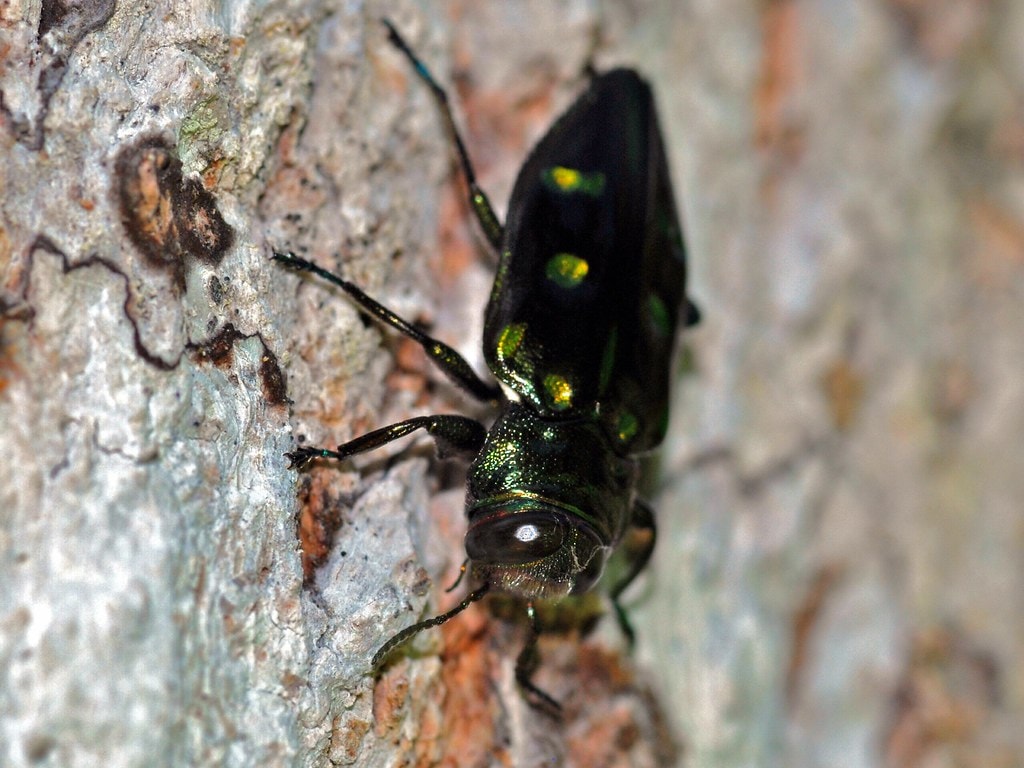
Flatheaded Borers (Metallic Wood Borers)
Family Buprestidae — multiple species
Buprestidae (Jewel Beetles)
Host trees / materials:
Identification signs:
- D-shaped exit holes: 4–12 mm flat-topped oval holes in bark (diagnostic)
- Serpentine galleries: flat, winding tunnels packed with frass visible under peeled bark
- Crown dieback: progressive branch death from the top down
- Bark staining: dark sap stains or pitch tubes at entry points
- Adults: metallic green, bronze, or copper beetles with flattened body profile
🔄 Complete Lifecycle — Egg to Adult
Egg
1–2 weeks
Females lay eggs in bark crevices, wounds, or under bark scales of stressed or recently dead trees. Eggs are white, flat, and scale-like. Females are attracted to the volatile compounds released by stressed trees — drought stress, construction damage, and transplant shock all increase attractiveness to egg-laying females.
Larva
1–3 years (species-dependent)
Larvae are the diagnostic stage — they have a distinctively enlarged, flattened thorax (the "flathead") and a long, narrow abdomen. They mine the cambium layer in flat, winding galleries that pack tightly with frass. Cambium destruction girdles branches and trunks, cutting off water and nutrient transport. A single heavily infested branch may have dozens of overlapping galleries.
Pupa
3–6 weeks
Pupation occurs in a pupal chamber at the end of the larval gallery, just beneath the bark surface or in the outer sapwood. The pupa is white and about the same size as the adult. Adults chew the characteristic D-shaped exit hole to emerge.
Adult
4–8 weeks
Adults are among the most visually striking beetles in Arizona — many species are brilliantly metallic green, bronze, copper, or blue-green. They are active during warm, sunny days and are strong fliers. Adults feed on foliage and pollen of host trees (minor damage) before mating and laying eggs. The D-shaped exit hole they leave is the most reliable field identification sign.
Arizona-Specific Context
Arizona has dozens of native Buprestidae species, many of which are important decomposers of dead wood in desert and riparian ecosystems. The species that cause significant damage to landscape trees are primarily those that attack stressed trees — the emerald ash borer (Agrilus planipennis), while not yet established in Arizona, is a major concern for the state's ash tree population. The two-lined chestnut borer (Agrilus bilineatus) and several Chrysobothris species are the most commonly encountered damaging species in Arizona landscapes.
Prevention
Maintain tree health through proper irrigation, fertilization, and pruning. Avoid wounding tree bark during landscaping. Wrap newly transplanted trees to prevent bark sunscald, which creates entry points. Remove and chip or burn dead and dying trees promptly — they serve as breeding reservoirs that produce adults that attack neighboring healthy trees. Avoid storing freshly cut wood near living trees.
Treatment
Chemical treatment is most effective as a preventive bark spray on high-value trees in areas with known flatheaded borer pressure. Systemic insecticides (imidacloprid, emamectin benzoate trunk injection) can protect individual high-value trees. Once larvae are established in the cambium, removal of infested branches is the primary mechanical control. Severely infested trees should be removed and destroyed to prevent adult emergence.
 Structural Lumber Risk
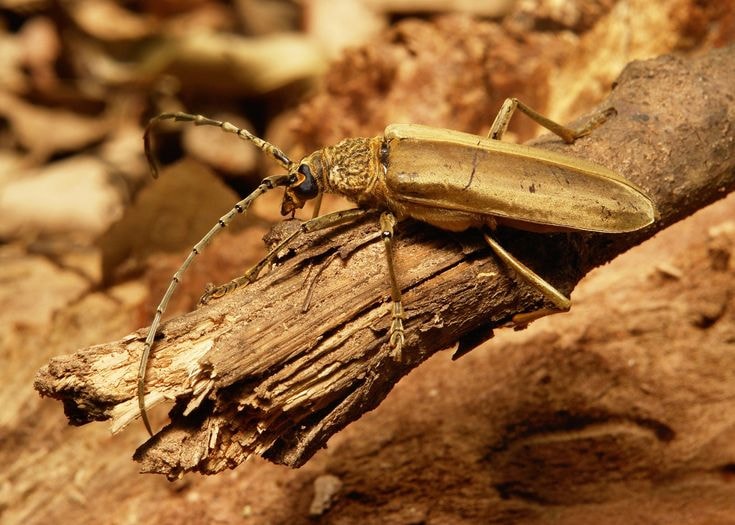
Roundheaded Borers (Longhorn Beetles)
Family Cerambycidae — multiple species
Cerambycidae (Longhorn Beetles)
Host trees / materials:
Identification signs:
- Oval exit holes: 6–12 mm oval holes in wood surface
- Coarse frass: cylindrical or pellet-shaped frass pushed from galleries
- Chewing sounds: larvae audible chewing inside wood at night in quiet rooms
- Rippling bark: raised, irregular bark surface over larval galleries
- Adults: elongated beetles with antennae as long as or longer than the body
🔄 Complete Lifecycle — Egg to Adult
Egg
1–3 weeks
Females lay eggs in bark crevices, wood checks, or directly on rough wood surfaces. The old house borer specifically targets the sapwood of structural pine lumber, laying eggs in cracks and joints. Eggs are white, elongated, and 2–4 mm long.
Larva
2–10 years (species-dependent)
Larvae are the most structurally damaging stage. They are large (up to 50 mm), creamy white, and cylindrical with a rounded head capsule (the "roundhead" that distinguishes them from flatheaded borers). They bore deep into sapwood and heartwood, creating large oval tunnels packed with coarse, cylindrical frass. The old house borer can remain active in structural lumber for up to 10 years, causing progressive structural weakening.
Pupa
3–8 weeks
Pupation occurs in a pupal chamber at the end of the larval gallery, near the wood surface. Adults chew an oval exit hole to emerge. In structural lumber, exit holes in finished surfaces are often the first sign of an infestation that has been active for years.
Adult
2–6 weeks
Adults are the familiar longhorn beetles — elongated, with antennae that are often as long as or longer than the body. Many species are attractively patterned with spots, bands, or mottled markings. Adults feed on pollen, bark, or foliage (minor damage) before mating. Some species are nocturnal; others are active during the day. Adults emerging from structural lumber inside a home are a reliable sign of an active infestation.
Arizona-Specific Context
The old house borer (Hylotrupes bajulus) is the most economically significant cerambycid in Arizona structures. It specifically targets the sapwood of pine lumber and can remain active in structural wood for up to 10 years. Infestations are often discovered during home renovations when exit holes are found in framing lumber. Arizona's dry climate slows but does not prevent old house borer development — infestations in low-humidity environments simply take longer to become apparent.
Prevention
Kiln-drying lumber before use kills all life stages and is the most effective prevention for structural infestations. Inspect firewood before bringing it indoors — firewood is a common introduction pathway for longhorn beetles. Treat exposed structural wood in crawl spaces and attics with borate-based wood preservatives (disodium octaborate tetrahydrate) as a preventive measure in high-risk areas.
Treatment
Surface treatment with residual insecticides (permethrin, bifenthrin) kills adults and newly hatched larvae before they penetrate the wood. Borate treatments (Tim-bor, Boracare) penetrate wood and kill larvae within galleries. Fumigation (methyl bromide, sulfuryl fluoride) is the most effective treatment for severe structural infestations — it penetrates all wood and kills all life stages. Heat treatment (raising wood temperature to 120°F+ for several hours) is an effective non-chemical alternative.
 Kills Trees Within Weeks
Bark Beetles
Dendroctonus spp., Ips spp., Scolytus spp.
Curculionidae: Scolytinae
Host trees / materials:
Identification signs:
- Pitch tubes: white, yellow, or reddish resin tubes on bark surface (tree defense response)
- Boring dust: reddish-brown frass in bark crevices and at tree base
- Gallery patterns: species-specific engraving patterns visible under bark (Ips = Y or H shape; Dendroctonus = irregular winding)
- Crown fade: needles turn yellow, then red, then gray — tree can die within 2–6 weeks of successful attack
- Blue-stain: sapwood stained blue-gray from fungal inoculation by beetles
🔄 Complete Lifecycle — Egg to Adult
Egg
1–2 weeks
After successfully overcoming tree defenses, the female constructs a maternal gallery in the phloem layer and lays eggs in niches along both sides of the gallery. Egg galleries are species-specific in shape — Ips species create Y- or H-shaped galleries; Dendroctonus species create long, winding galleries. A single female lays 40–80 eggs.
Larva
4–12 weeks
Larvae mine outward from the maternal gallery, creating the characteristic fan-shaped larval gallery pattern visible under peeled bark. They feed on the phloem — the nutrient-conducting layer between bark and wood. Larval galleries collectively girdle the tree, cutting off nutrient transport. Larvae also inoculate the wood with blue-stain fungi that block water transport, accelerating tree death.
Pupa
1–3 weeks
Pupation occurs in a pupal chamber at the end of the larval gallery, just inside the outer sapwood. Pupae are white and about the same size as the adult. Adults chew a small, round exit hole (1.5–3 mm) to emerge.
Adult
2–8 weeks
Newly emerged adults are pale and soft (teneral) for several days before hardening. They fly to new host trees, attracted by aggregation pheromones released by pioneer beetles already attacking a tree. Mass attacks by hundreds or thousands of beetles simultaneously overwhelm tree defenses — a healthy tree can repel a few beetles with resin, but cannot repel a mass attack. Adults of some species overwinter in the duff layer or in bark crevices.
Arizona-Specific Context
Arizona has two distinct bark beetle environments: the high-elevation forests of the White Mountains, Mogollon Rim, and Sky Islands, where Dendroctonus and Ips species periodically cause large-scale mortality events in ponderosa pine and spruce-fir forests; and the low-elevation desert and urban landscape, where Scolytus species occasionally attack stressed mesquite and ornamental trees. The 2002–2003 drought triggered one of the largest bark beetle outbreaks in Arizona history, killing millions of ponderosa pines across the state.
Prevention
Maintain tree vigor through proper irrigation, especially during drought. Avoid wounding trees during landscaping. Remove and destroy infested trees promptly to prevent adult emergence and spread. Preventive bark sprays (carbaryl, permethrin) applied to the lower trunk and major branches of high-value trees can deter egg-laying. Verbenone pouches (anti-aggregation pheromone) can be used to make individual trees less attractive to mass attack.
Treatment
Once a tree is successfully attacked and showing crown fade, it cannot be saved — the phloem and water transport system are already destroyed. Infested trees should be removed and the wood chipped, burned, or buried to prevent adult emergence. Bark beetle management is primarily a forest-level concern in Arizona's mountain forests; urban landscape trees are occasionally attacked but mass outbreaks are rare in irrigated urban settings.
 Reduces Wood to Fine Powder
Powderpost Beetles
Lyctus spp., Anobium spp., Bostrichidae
Bostrichidae / Ptinidae / Lyctidae
Host trees / materials:
Identification signs:
- Round exit holes: 1–3 mm perfectly round holes in wood surface
- Fine powder frass: talcum-like powder falling from holes (lyctid) or gritty, bun-shaped pellets (anobiid)
- Fresh frass: cream-colored, loose powder indicates active infestation; gray, packed frass indicates old/inactive
- Structural weakening: wood that crumbles or collapses under pressure
- Adults: tiny (1–7 mm), reddish-brown to black beetles found near infested wood
🔄 Complete Lifecycle — Egg to Adult
Egg
1–4 weeks
Females lay eggs in wood pores, checks, or end grain of susceptible wood. Lyctid beetles require wood with starch content above a minimum threshold — they attack only the sapwood of ring-porous hardwoods (oak, ash, hickory) and bamboo. Anobiid beetles (including the furniture beetle, Anobium punctatum) have broader wood preferences and attack both hardwood and softwood.
Larva
1–5 years (species and conditions)
Larvae are small (1–5 mm), C-shaped, and creamy white. They bore through the wood, consuming the starchy sapwood and leaving behind a network of tunnels packed with fine frass. In Arizona's dry climate, larval development is slower than in humid environments — infestations may take 3–5 years to become apparent. The wood surface appears intact while the interior is being consumed.
Pupa
2–4 weeks
Pupation occurs in a pupal chamber just beneath the wood surface. Adults chew the characteristic round exit hole to emerge. Exit holes in finished flooring or furniture are often the first sign of an infestation that has been active for years.
Adult
1–4 weeks
Adults are small (1–7 mm), reddish-brown to black beetles. They emerge in spring and summer, mate, and lay eggs in new wood. Adults found on windowsills near infested wood are a reliable sign of active infestation — they are attracted to light and often found dead on windowsills after failing to escape. Adults do not feed and cause no direct wood damage.
Arizona-Specific Context
Powderpost beetles are the most economically significant wood-destroying beetles in Arizona structures. Lyctid beetles are particularly common in Arizona because of the widespread use of oak and ash hardwood flooring, which provides ideal host material. Arizona's dry climate slows but does not prevent infestations — the low humidity simply extends the larval development period, meaning infestations take longer to become apparent but can still cause significant structural damage over time.
Prevention
Kiln-drying lumber and hardwood flooring before installation kills all life stages and is the most effective prevention. Inspect antique furniture and reclaimed wood before bringing it into the home. Apply borate wood preservatives (Boracare, Tim-bor) to exposed wood in crawl spaces and attics. Maintain low indoor humidity — powderpost beetles require wood moisture content above 8% for successful development; Arizona's dry climate naturally inhibits some species.
Treatment
Surface treatment with residual insecticides (permethrin, bifenthrin) kills adults and newly hatched larvae before they penetrate. Borate treatments (Boracare, Tim-bor) penetrate wood and kill larvae within galleries — most effective on bare, unfinished wood. Fumigation is the most effective treatment for severe infestations in furniture and structural wood. Heat treatment (120°F+ for several hours) is effective for furniture and portable items. Freezing (-20°F for 72 hours) kills all life stages in small items.
The key distinction between wood-destroying beetles and other structural pests like termites is the nature of the damage and the treatment approach. Termites consume wood continuously as a colony, and their damage is driven by colony size and foraging range. Wood-destroying beetles, by contrast, cause damage through individual larval development — each larva creates its own gallery system, and the cumulative damage from many larvae over many years is what causes structural failure. This means that beetle infestations are often slower to cause critical structural damage than termite infestations, but they are also harder to detect early. The exit hole that appears in a hardwood floor or structural beam is the end of a larval development cycle that may have taken 2–5 years — the infestation has been active for years before the first visible sign appears. For bark beetles attacking living trees, the timeline is reversed — damage is rapid and visible within weeks of a successful attack, but by the time crown fade is apparent, the tree is already dead. The practical implication is that prevention and early detection are far more valuable than reactive treatment for both categories. Maintaining tree health, using kiln-dried lumber, applying borate wood preservatives to exposed structural wood, and inspecting wood products before bringing them into the home are all more cost-effective than treating an established infestation.
When to Call a Professional for Wood-Destroying Beetles
Exit holes in structural framing
Round or oval exit holes in floor joists, wall studs, or roof framing indicate an active or past infestation that requires professional assessment to determine extent and structural impact.
Powder or frass falling from wood
Fine powder (powderpost beetle) or coarse frass (longhorn borer) falling from wood surfaces indicates active larval feeding. The infestation may be far more extensive than the visible exit holes suggest.
Adults emerging from walls or floors
Beetles emerging from finished surfaces — hardwood flooring, paneling, or trim — indicate an infestation that has been active for years inside the wood. Professional treatment is required to prevent continued damage.
Tree decline with exit holes at base
A palo verde, mesquite, or ornamental tree showing crown dieback with large exit holes at the base or sawdust mounds in the soil requires professional assessment to determine whether removal is necessary for safety.
Professional treatment for wood-destroying beetles depends entirely on the species, the extent of infestation, and the type of wood affected. For structural infestations in homes — powderpost beetles in hardwood flooring, old house borers in framing lumber — the treatment hierarchy is: surface insecticide treatment for accessible wood, borate penetrant treatment for bare or lightly finished wood, and fumigation for severe or inaccessible infestations. Heat treatment is an effective non-chemical alternative for furniture and portable items. For tree infestations, the calculus is different: bark beetles and flatheaded borers attacking living trees require rapid response — infested trees should be removed and destroyed before adults emerge to attack neighboring trees. Palo verde root borers and roundheaded borers in trees are managed primarily through tree health maintenance, since chemical treatment of deep root and heartwood infestations is largely ineffective. At Pest Control Bros, we conduct thorough wood-destroying beetle inspections as part of our standard pest assessment, identifying exit holes, frass patterns, and active infestation signs that are easy to miss without training. Free inspections, no contracts, same-week service across Maricopa, Chandler, Casa Grande, Tempe, Gilbert, and Mesa.
Seeing exit holes, frass, or beetles in your wood?
Pest Control Bros inspects for wood-destroying beetles in structures and landscapes across Mesa, Tempe, Gilbert, Chandler, Casa Grande, and Maricopa. Free inspection, no contracts, same-week service.


