

Arizona Pantry Pests: Complete Guide to Identification, Lifecycles & Infestation Stages
Pantry pests are among the most frustrating infestations an Arizona homeowner can face — not because they are dangerous, but because they are invisible until the infestation is already well established, they contaminate food that cannot be salvaged, and they are almost always introduced into the home through purchased grocery products rather than through any failure of cleanliness or sanitation. The Indian meal moth larvae already present in that bag of cornmeal from the grocery store, the grain weevil eggs hidden inside individual rice kernels, the flour beetle adults that chewed through the cardboard box of cake mix — none of these entered through a crack in your foundation or a gap in your window screen. They came home with your groceries. Arizona's climate makes the situation significantly worse than in most states. The combination of year-round warm temperatures, summer heat that can push pantry temperatures to 85–95°F, and the absence of a cold winter that would otherwise reset pest populations creates near-ideal breeding conditions for all pantry pest species. A flour beetle population that might produce 3 generations per year in Minnesota produces 5–6 in Arizona. An Indian meal moth infestation that takes 3 months to become noticeable in a cool northern pantry can reach the same level in 6 weeks in a Phoenix kitchen. Understanding the biology of each species — what it eats, how it develops, and how an infestation progresses — is the foundation of effective control.
Why Arizona Pantry Pest Infestations Are Worse Than Most States
Year-round breeding
Arizona's mild winters mean pantry pests never experience a cold-weather population reset. Infestations that start in summer continue growing through fall and winter without interruption.
Accelerated development
Most pantry pest lifecycles are temperature-dependent. At 100°F+ summer temperatures, Indian meal moth larvae can complete development in 3–4 weeks instead of the 8–12 weeks typical in cooler climates. More generations per year means faster population growth.
Pantry temperatures
Arizona homes without climate-controlled pantries can reach 85–95°F in summer — near-ideal breeding temperatures for most pantry pest species. Even air-conditioned homes often have pantries warmer than the rest of the house.
Which Foods Are at Highest Risk?
| Food Product | Pests That Infest It | Risk Level |
|---|---|---|
| All-purpose flour | Indian Meal Moth, Red/Confused Flour Beetle, Mediterranean Flour Moth, Drugstore Beetle | Very High |
| Dry cereals & granola | Indian Meal Moth, Red/Confused Flour Beetle | High |
| Whole grain rice | Rice Weevil, Granary Weevil | High |
| Spices & dried herbs | Drugstore Beetle, Cigarette Beetle, Indian Meal Moth | High |
| Dried fruit & nuts | Indian Meal Moth, Drugstore Beetle, Mediterranean Flour Moth | High |
| Pet food & birdseed | Indian Meal Moth, Drugstore Beetle, Red/Confused Flour Beetle | High |
| Pasta (dry) | Granary Weevil, Drugstore Beetle, Mediterranean Flour Moth | Moderate |
| Chocolate & cocoa | Indian Meal Moth, Mediterranean Flour Moth, Drugstore Beetle | Moderate |
| Cornmeal & grits | Indian Meal Moth, Red/Confused Flour Beetle, Mediterranean Flour Moth | High |
| Cake & baking mixes | Indian Meal Moth, Red/Confused Flour Beetle, Drugstore Beetle | High |
5 Arizona Pantry Pests: Identification, Lifecycle & Control
 Most Common Pantry Pest in AZ
Indian Meal Moth
Plodia interpunctella
Foods infested:
Complete Lifecycle — Egg to Adult
Egg
2–14 days
Females lay 100–400 tiny, grayish-white eggs directly on or near food surfaces. Eggs are nearly invisible to the naked eye — 0.3 mm long — and are often laid in crevices of packaging or directly on grain surfaces. In Arizona's summer heat, eggs hatch in as few as 2 days.
Larva
13–288 days (temperature-dependent)
The larval stage is the only damaging stage — larvae are the ones eating your food. Cream-colored caterpillars with a brown head, up to 13 mm long, they spin characteristic silken webbing as they feed, matting food particles together. In Arizona's warm pantries, larval development can complete in as few as 4 weeks. Larvae are often the first sign of infestation — look for webbing and small worms in grain products.
Pupa
15–30 days
Mature larvae leave the food source and wander — often traveling several feet — to find a sheltered pupation site. They spin a silken cocoon in cracks, corners, cabinet hinges, or behind shelving. This wandering behavior is why you often find larvae or cocoons far from the infested food. Pupae are tan to brown and about 6–8 mm long.
Adult
4–7 weeks
Adults are the familiar small moths with distinctive two-toned wings — reddish-brown outer half, pale gray inner half. They do not eat and cause no direct food damage, but females lay the next generation of eggs. Adults are most active at dusk and are attracted to light. Seeing adult moths flying in your kitchen is a reliable sign of an established infestation.
How an Infestation Progresses
Stage 1 — Entry
Infestation almost always begins with infested product brought home from the store. Eggs or young larvae are present in the packaging before purchase — this is not a failure of home cleanliness. Bulk bins, pet food bags, and birdseed are the highest-risk entry points.
Stage 2 — Establishment
Larvae hatch and begin feeding inside the original package. Webbing and frass accumulate inside the bag or box. The infestation is entirely contained at this point and may go unnoticed for weeks.
Stage 3 — Spread
Mature larvae exit the original package and wander to pupate. Adults emerge and females lay eggs in adjacent food packages. The infestation now spans multiple products and potentially multiple cabinets.
Stage 4 — Established
Multiple overlapping generations are present simultaneously — eggs, larvae, pupae, and adults all active at the same time. Webbing is visible in multiple products. Adults are seen flying regularly. Full pantry cleanout required.
Prevention
Store all grain products, cereals, flour, and pet food in airtight glass or hard plastic containers immediately after purchase. Inspect packaging for small holes, webbing, or larvae before buying. Freeze new grain products for 72 hours before storing — this kills any eggs or larvae present. Bay leaves placed in grain containers repel adults but do not kill existing infestations.
Treatment
Remove and discard all infested products. Vacuum all cabinet shelves, cracks, and corners thoroughly. Wipe shelves with white vinegar. Pheromone traps (Indian meal moth specific) capture adult males and monitor for reinfestation. Do not use insecticide sprays inside food cabinets — they are ineffective against larvae inside packaging and contaminate food surfaces.
 Develops Inside Whole Grains
Grain & Rice Weevil
Sitophilus granarius / Sitophilus oryzae
Foods infested:
Complete Lifecycle — Egg to Adult
Egg
3–5 days
The female chews a small hole into a grain kernel, deposits a single egg inside, and seals the hole with a gelatinous plug. The egg is completely hidden inside the kernel — there is no external sign of infestation at this stage. A single female lays 300–400 eggs over her lifetime, one per kernel.
Larva
18–35 days
The larva develops entirely inside the grain kernel, feeding on the starchy interior. The kernel appears intact from the outside but is hollow inside. This internal development makes weevil infestations nearly impossible to detect until adults emerge. Larvae are white, legless, and C-shaped.
Pupa
6–18 days
Pupation also occurs inside the grain kernel. The pupa transforms into an adult within the kernel. Just before emergence, the adult chews a circular exit hole through the kernel wall.
Adult
7–8 months
Adults are small (2.5–4.5 mm), reddish-brown to black beetles with a distinctive long snout (rostrum). They are flightless (granary weevil) or capable of short flights (rice weevil). Adults feed on grain surfaces and are the first visible sign of infestation — finding small dark beetles in grain products means larvae have been developing inside kernels for weeks.
How an Infestation Progresses
Stage 1 — Hidden entry
Infested grain is purchased with eggs already inside kernels. No external signs are visible. The infestation is completely hidden inside individual grain kernels.
Stage 2 — Internal development
Larvae develop inside kernels over 3–5 weeks. Grain appears normal. The only clue may be a slightly musty odor from accumulated frass inside kernels.
Stage 3 — Adult emergence
Adults chew exit holes and emerge from kernels. Hollow, exit-holed kernels and small dark beetles become visible. Grain may appear dusty from frass.
Stage 4 — Active infestation
Adults mate and females begin laying eggs in remaining intact kernels. Population grows rapidly. Grain is heavily contaminated with frass, shed skins, and dead beetles.
Prevention
Store whole grains, rice, and pasta in airtight containers. Freeze whole grain products for 72 hours before long-term storage — this kills all life stages including eggs inside kernels. Inspect grain for small exit holes or dark beetles before purchase. Rotate stock — use oldest products first and do not store grain for more than 3–4 months without inspection.
Treatment
Discard all infested grain products. Vacuum storage containers and shelves. Freeze any grain products you are unsure about for 72 hours before returning to storage. Airtight containers prevent reinfestation. No insecticide treatment is appropriate for food storage areas.
 Thrives in AZ Heat
Red & Confused Flour Beetle
Tribolium castaneum / Tribolium confusum
Foods infested:
Complete Lifecycle — Egg to Adult
Egg
5–12 days
Females lay 300–500 eggs loosely in flour or other fine grain products over their lifetime. Eggs are white, sticky, and coated with flour particles, making them nearly invisible in infested products. Unlike weevils, eggs are laid on the food surface rather than inside individual kernels.
Larva
22–100 days
Larvae are slender, yellowish-white, and up to 6 mm long with a distinctive two-pronged tail. They feed on flour and fine grain products, producing a characteristic pinkish tint and musty, medicinal odor in infested flour — caused by quinone secretions. In Arizona's summer heat (100°F+), larval development can complete in as few as 3 weeks.
Pupa
8–17 days
Pupation occurs in the food product or in cracks and crevices nearby. Pupae are white to yellowish and about 3–4 mm long. They are often found in clumped flour or in the corners of packaging.
Adult
3+ years
Adults are small (3–4 mm), shiny reddish-brown beetles. The red flour beetle can fly; the confused flour beetle cannot. Both produce quinone secretions that give infested flour a distinctive pinkish color and musty odor — flour that smells "off" or has a pinkish tint is almost certainly infested. Adults are extremely long-lived and can survive for over 3 years, making established infestations persistent.
How an Infestation Progresses
Stage 1 — Entry
Infested flour or grain product is brought home, or adults enter through gaps in packaging. Flour beetles can chew through cardboard and thin plastic bags.
Stage 2 — Rapid reproduction
Females begin laying eggs immediately in flour. At Arizona summer temperatures, a new generation can complete in 3–4 weeks. Population grows exponentially.
Stage 3 — Contamination
Flour develops a pinkish tint and musty odor from quinone secretions. Larvae, shed skins, frass, and eggs are visible throughout the product. The flour is no longer safe to use.
Stage 4 — Spread
Adults disperse to adjacent products. Infestation spreads to spices, cereals, cake mixes, and other fine-grain products throughout the pantry. Multiple products contaminated simultaneously.
Prevention
Transfer flour and baking mixes to airtight glass or hard plastic containers immediately after purchase — flour beetles can chew through cardboard and thin plastic. Do not store flour for more than 3 months without inspection. Arizona's heat accelerates reproduction dramatically — pantry temperatures above 85°F create near-ideal breeding conditions year-round.
Treatment
Discard all infested products and any products stored in the same cabinet. Vacuum shelves and wipe with white vinegar. Wash all storage containers with hot soapy water before reuse. The distinctive musty odor of quinone secretions can persist in wood shelving — wipe thoroughly. Pheromone traps are available for flour beetles and help monitor for reinfestation.
 Widest Food Range of Any Pantry Pest
Drugstore & Cigarette Beetle
Stegobium paniceum / Lasioderma serricorne
Foods infested:
Complete Lifecycle — Egg to Adult
Egg
6–10 days
Females lay 75–100 white, oval eggs loosely in or near food material. Eggs are tiny (0.5 mm) and difficult to see without magnification. They are laid directly in food products or in cracks and crevices of packaging.
Larva
30–60 days
Larvae are small (up to 4 mm), creamy white, and slightly curved with a brown head. They are covered in fine hairs. Larvae feed voraciously and can penetrate sealed packaging — they are capable of chewing through aluminum foil, thin plastic, and cardboard. The drugstore beetle larva is one of the few insects that can digest and survive on capsaicin-containing spices like cayenne pepper.
Pupa
12–18 days
Larvae construct a small oval cocoon from food particles and silk before pupating. Cocoons are found in food products, in cracks in shelving, or inside packaging. The cocoon is about 3–4 mm long and tan to brown.
Adult
2–4 months
Adults are small (2–3.5 mm), oval, reddish-brown beetles covered in fine golden hairs. They are strong fliers and are attracted to light. Adults do not feed and cause no direct food damage, but females lay the next generation of eggs. The drugstore beetle is distinguished from the cigarette beetle by its serrated antennae and grooved wing covers.
How an Infestation Progresses
Stage 1 — Entry
Infested spices, herbs, or packaged food are brought home. Drugstore beetles are particularly common in spice racks — paprika, cayenne, and dried herbs are high-risk entry points that are often overlooked.
Stage 2 — Penetration
Larvae chew through packaging to access adjacent products. Unlike most pantry pests, drugstore beetle larvae can penetrate sealed containers, aluminum foil, and thick plastic bags.
Stage 3 — Multi-product infestation
Infestation spreads rapidly due to the species' extremely broad food range. Spices, cereals, pet food, and dried herbs may all be infested simultaneously.
Stage 4 — Structural infestation
In severe cases, larvae pupate in wood shelving, wall voids, and cabinet cracks. Adults emerge from the structure itself, making reinfestation persistent even after all food is removed.
Prevention
Store all spices in airtight glass jars — this species is the primary reason spice racks should never use open or loosely sealed containers. Inspect spice purchases carefully; bulk spices are a common infestation source. Replace spices older than 12 months. Drugstore beetles can penetrate most flexible packaging — glass and hard plastic are the only reliable barriers.
Treatment
Discard all infested products including spices, herbs, and pet food. Inspect and discard any product that has been stored for more than 12 months. Vacuum all cabinet cracks and shelving. In severe infestations where adults are emerging from the structure, professional treatment of wall voids and cabinet interiors may be necessary.
 Heavy Webbing Producer
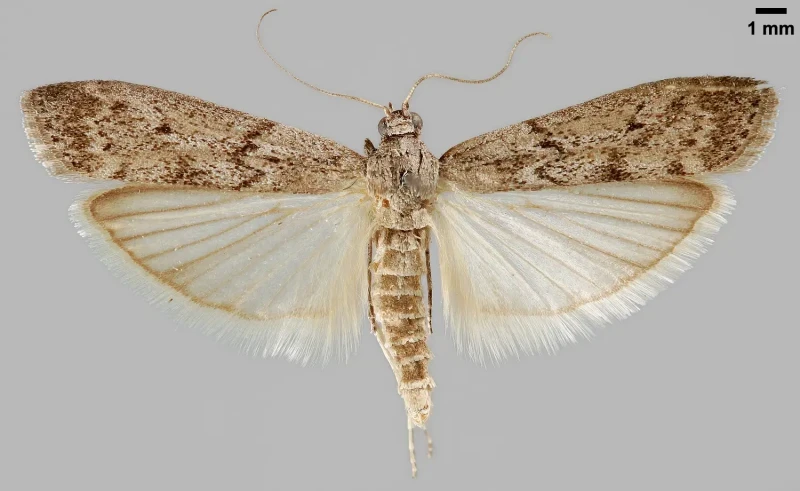
Mediterranean Flour Moth
Ephestia kuehniella
Foods infested:
Complete Lifecycle — Egg to Adult
Egg
3–8 days
Females lay 116–678 eggs in flour or grain products over 3–10 days. Eggs are white to pinkish, oval, and about 0.5 mm long. They are laid loosely in food material and are nearly invisible without magnification.
Larva
35–100 days
Larvae are the most distinctive of all pantry pest larvae — they produce copious amounts of silken webbing that mats flour into dense, tunnel-like masses. A heavily infested bag of flour will be almost entirely webbed together and unusable. Larvae are pinkish-white with a dark head, up to 18 mm long. The webbing is the most reliable identification sign.
Pupa
8–12 days
Larvae spin a dense silken cocoon, often incorporating flour particles. Pupation occurs in the food product or in cracks and crevices of the storage area. Cocoons are white to gray and about 8–10 mm long.
Adult
2–3 weeks
Adults are larger than Indian meal moths (20–25 mm wingspan) with pale gray wings crossed by dark zigzag bands. They are nocturnal and rest with wings folded flat over the body. Adults do not feed. Seeing these moths in your kitchen at night is a reliable sign of an active flour infestation.
How an Infestation Progresses
Stage 1 — Entry
Infested flour is purchased from the store. This species is more common in commercial flour than in home pantries, but home infestations do occur from purchased product.
Stage 2 — Webbing development
Larvae begin spinning webbing throughout the flour. The flour becomes matted and clumped. A distinctive musty odor develops.
Stage 3 — Dense infestation
Flour is heavily webbed and unusable. Larvae are visible throughout the product. Webbing may extend outside the bag into adjacent products.
Stage 4 — Adult emergence
Adults emerge and fly at night. Females lay eggs in adjacent flour products. Infestation spreads to other flour-based products in the pantry.
Prevention
Transfer flour to airtight containers immediately after purchase. Inspect flour bags for webbing or clumping before purchase — this is the most reliable pre-purchase detection method. Freeze flour for 72 hours before long-term storage. Rotate flour stock and do not store flour for more than 3 months.
Treatment
Discard all infested flour and grain products. The dense webbing produced by this species can clog vacuum filters — use a disposable bag or empty the canister immediately after vacuuming. Wipe shelves with white vinegar. Pheromone traps designed for Ephestia moths are available and effective for monitoring.

Heavily infested grain products showing frass, shed skins, and insect damage — all must be discarded, not salvaged.
The single most important thing to understand about pantry pest control is that chemical treatment is almost never the right answer. Insecticide sprays applied inside food storage cabinets contaminate food surfaces, are ineffective against larvae inside sealed packaging, and do nothing to address the root cause of the infestation — infested food products that need to be removed. The correct response to a pantry pest infestation is always the same: find and discard every infested product, clean the storage area thoroughly, and transfer all remaining food to airtight containers. Pheromone traps are the one chemical tool that is appropriate for pantry pest management — they use species-specific sex pheromones to capture adult males, reducing the mating population and providing ongoing monitoring for reinfestation. They are available for Indian meal moths, Mediterranean flour moths, and flour beetles at most hardware stores and online. The most common mistake homeowners make is discarding only the obviously infested products and leaving everything else in place. Pantry pest eggs are microscopic and can be present in any grain product in the same cabinet as an infested product — even products in sealed packaging, because adults can chew through cardboard and thin plastic. A thorough cleanout means removing and inspecting every item, discarding anything that cannot be verified as pest-free, and transferring everything else to airtight glass or hard plastic containers before returning it to the pantry.
Complete Pantry Cleanout — Step by Step
- 1
Remove everything from the pantry
Take out every item — including canned goods, which can harbor pests in their labels and lids. Place items on a clean surface for inspection.
- 2
Inspect every package
Check for webbing, larvae, frass (fine powder or pellets), exit holes, or live insects. Any product showing signs of infestation must be discarded — do not attempt to salvage infested food.
- 3
Discard in a sealed bag outside
Place infested products in a sealed plastic bag and take them directly to an outdoor trash can. Do not leave infested products in an indoor trash can — adults will emerge and reinfest.
- 4
Vacuum all surfaces
Vacuum every shelf, crack, corner, and hinge thoroughly. Use a crevice tool for corners and shelf brackets. Empty the vacuum canister or dispose of the bag immediately outside.
- 5
Wipe with white vinegar
Wipe all shelf surfaces with undiluted white vinegar. This kills eggs and larvae on contact and removes pheromone trails that attract returning adults. Allow to dry completely before restocking.
- 6
Transfer to airtight containers
Before returning any food to the pantry, transfer all grain products, flour, cereals, spices, and pet food to airtight glass or hard plastic containers. Label with the purchase date.
- 7
Place pheromone traps
Install species-specific pheromone traps (Indian meal moth, flour beetle) to monitor for any surviving adults or reinfestation from missed eggs.
Prevention is far more effective than treatment for pantry pests, and it requires only two consistent habits: airtight storage and regular inspection. Airtight glass or hard plastic containers with secure lids are the single most effective pantry pest prevention tool available. They prevent adults from accessing food to lay eggs, prevent larvae from escaping infested products to spread to adjacent items, and make it easy to inspect food products visually. Cardboard boxes, paper bags, and thin plastic bags provide no meaningful barrier — flour beetles and drugstore beetles can chew through all of them. The second habit — regular inspection — means checking grain products, flour, cereals, spices, and pet food every 4–6 weeks for signs of infestation: webbing, larvae, frass, exit holes, or live insects. Products that have been stored for more than 3–4 months without inspection should be inspected carefully before use. Freezing new grain products for 72 hours before storing them kills any eggs or larvae present in the product at purchase — this is particularly valuable for bulk grains, specialty flours, and birdseed, which are the highest-risk entry points for pantry pest infestations. At Pest Control Bros, we treat persistent pantry pest infestations that have spread beyond food products into wall voids, cabinet interiors, and structural cracks — situations where a DIY cleanout alone is insufficient. Free inspections, no contracts, same-week service across Maricopa, Chandler, Casa Grande, Tempe, Gilbert, and Mesa.
Pantry pests coming back after cleanout?
Persistent infestations often mean pests are breeding in wall voids, cabinet interiors, or structural cracks — not just in food products. Pest Control Bros serves Mesa, Tempe, Gilbert, Chandler, Casa Grande, and Maricopa. Free inspection, no contracts, same-week service.


